
Phase 1 vs. Phase 2 ESA: What’s the Difference?
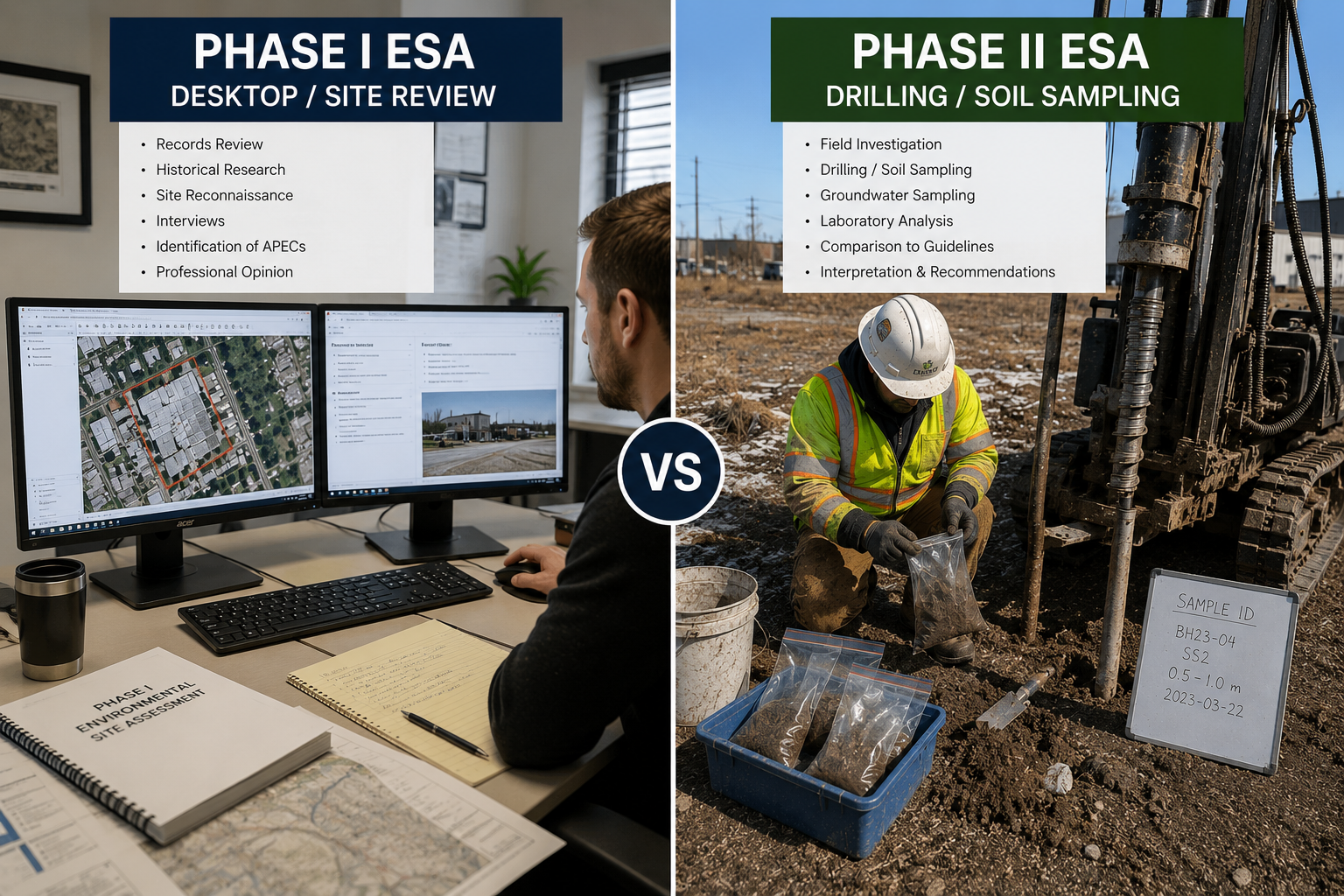
Phase I and Phase II ESAs serve different purposes within environmental due diligence and contaminated site assessment.
If you have been involved in a commercial real estate transaction, redevelopment project, financing review, or environmental regulatory process in Alberta, you have likely encountered the terms Phase 1 Environmental Site Assessment (ESA) and Phase 2 Environmental Site Assessment (ESA).
Although the terms are often used together, they serve different purposes.
A Phase 1 ESA is a non-intrusive environmental due diligence review based on records, interviews, and site observations. A Phase 2 ESA is a field-based investigation involving environmental sampling and laboratory analysis.
Understanding the difference is important for managing environmental risk, project timelines, budgets, and regulatory expectations.
Key Difference
A Phase 1 ESA is based on records review, interviews, and site reconnaissance. It does not typically involve soil, groundwater, surface water, sediment, or soil vapour sampling.
A Phase 2 ESA involves intrusive or physical investigation, including sample collection, laboratory analysis, and comparison of results to applicable environmental guidelines.
Standards and Regulatory Context in Alberta
In Alberta, environmental site assessments are commonly completed in accordance with CSA standards and applicable provincial requirements.
The CSA standard for Phase 1 ESAs is CSA Z768-01 (R2022), Phase I Environmental Site Assessment. The CSA standard for Phase 2 ESAs is CAN/CSA Z769-00 (R2023), Phase II Environmental Site Assessment. Alberta’s Environmental Site Assessment Standard, 2024 edition, provides provincial requirements for Phase 1 ESAs, Phase 2 ESAs, and confirmatory assessments where reports are submitted to Alberta Environment and Protected Areas or the Alberta Energy Regulator.
The applicable requirements depend on the purpose of the assessment. A lender-driven due diligence report, a municipal development submission, and a regulatory closure submission may each have different expectations.
Where an ESA is prepared for regulatory submission in Alberta, the report may need to be signed and stamped by an appropriately qualified professional registered with an applicable Alberta professional regulatory organization.
What Is a Phase 1 Environmental Site Assessment?
A Phase 1 ESA is typically the first stage of environmental due diligence. Its purpose is to identify whether current or historical site activities may have created potential environmental concerns.
A Phase 1 ESA is non-intrusive. It is based on available information, professional interpretation, and site observations — not laboratory confirmation.
A typical Phase 1 ESA includes:
records review;
site reconnaissance;
interviews with knowledgeable parties; and
preparation of a report and professional opinion.
Records Review
The assessor reviews available information relating to the subject property and surrounding area. This may include:
historical aerial photographs;
land titles;
city directories;
fire insurance plans;
historical maps;
regulatory databases; and
prior environmental reports.
The objective is to identify activities that may have resulted in a release of contaminants.
Site Reconnaissance
A site visit is completed to observe current property conditions. The assessor may look for indicators such as:
above-ground storage tanks;
chemical storage areas;
staining;
stressed vegetation;
fill material;
drainage concerns; or
waste handling areas.
Interviews
Interviews may be completed with current or former owners, occupants, operators, municipal representatives, or other knowledgeable parties to help identify historical activities that may not be fully documented in records.
Reporting and Professional Opinion
The Phase 1 ESA report summarizes the findings and identifies Areas of Potential Environmental Concern (APECs) and Contaminants of Potential Concern (CoPCs), where applicable.
The report may also recommend whether further investigation is warranted.
Important Limitation of a Phase 1 ESA
A Phase 1 ESA does not confirm whether contamination is present or absent.
It provides a professional opinion based on the available information, site observations, and scope of work completed at the time of the assessment.
Data gaps, limited historical records, restricted site access, seasonal conditions, or unavailable interviews can affect the conclusions and should be clearly documented in the report.
What Is a Phase 2 Environmental Site Assessment?
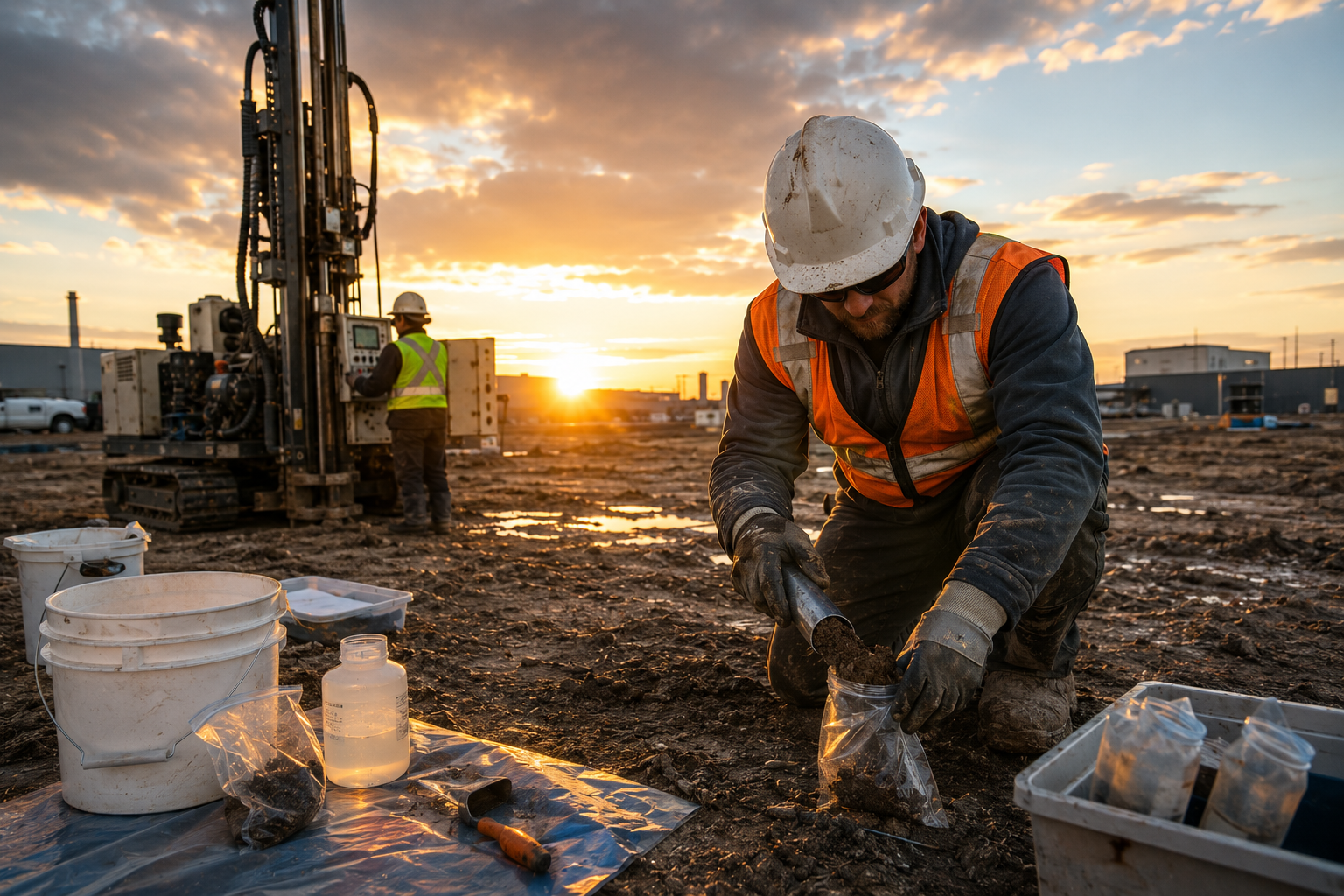
Environmental professionals conducting a Phase 2 Environmental Site Assessment involving soil sampling and subsurface investigation at an industrial redevelopment site.
A Phase 2 ESA is a field-based environmental investigation used to evaluate whether contaminants are present in soil, groundwater, surface water, sediment, or soil vapour.
A Phase 2 ESA is commonly recommended when a Phase 1 ESA identifies APECs or other potential contamination concerns requiring physical confirmation.
For example, a former gas station property may require a Phase 2 ESA to evaluate potential petroleum hydrocarbon impacts in soil and groundwater before redevelopment proceeds.
The objective is to determine whether contaminants are present, at what concentrations, and whether further assessment, remediation, risk management, or regulatory reporting may be required.
What a Phase 2 ESA Typically Involves
Depending on the site and scope, a Phase 2 ESA may include:
Planning
development of a sampling and analysis plan;
utility locates; and
health and safety planning.
Field Investigation
borehole drilling;
test pitting;
hand augering;
direct-push sampling;
soil sampling; and
groundwater monitoring well installation and sampling.
Laboratory Analysis
laboratory testing by an accredited laboratory; and
comparison of analytical results to applicable criteria.
Interpretation and Reporting
interpretation of contaminant distribution and potential risk;
delineation of impacts, where required; and
recommendations for additional assessment, remediation, or closure.
Phase 2 investigations are often iterative. Initial investigation results may lead to additional delineation work to better understand the horizontal and vertical extent of impacts.
Comparison to Alberta Guidelines
In Alberta, analytical results are commonly compared to the applicable Alberta Tier 1 Soil and Groundwater Remediation Guidelines or other applicable criteria, depending on the site, land use, exposure pathways, and regulatory context.
Where concentrations exceed applicable criteria, additional assessment, remediation, risk management, or Tier 2 evaluation may be required.
Applicable land use categories may include:
residential/parkland;
commercial;
industrial;
agricultural; or
natural area.
Phase 2 ESA and Regulatory Submissions
Some Phase 2 ESA reports may be prepared for regulatory purposes, including:
substance release reporting;
remediation planning;
risk management; or
site closure support.
In these cases, Alberta’s ESA Standard and applicable AEP or AER requirements should be reviewed carefully.
Additional forms, checklists, declarations, or supporting documentation may be required depending on the regulatory pathway and submission type.
What About a Phase 3 ESA?
The term Phase 3 ESA is sometimes used in industry to describe advanced delineation, remedial investigation, remediation planning, or confirmatory assessment work completed after contamination has been identified.
However, in Alberta practice, this work is often addressed within broader Phase 2, remediation, or risk management programs rather than treated as a separate formal assessment stage.
For clarity, it is often more useful to describe the specific scope of work being completed, such as:
supplemental delineation;
remedial excavation;
confirmatory sampling;
risk assessment;
remediation planning; or
closure support.
When Is a Phase 1 ESA Typically Needed?
A Phase 1 ESA may be requested or required for:
commercial or industrial property purchases;
refinancing or lender due diligence;
redevelopment projects;
municipal planning or development applications;
mergers and acquisitions involving land assets;
environmental insurance underwriting;
pre-lease or end-of-lease baseline reviews;
legal or transactional due diligence; or
internal corporate risk management.
A Phase 1 ESA is often the starting point because it helps determine whether further environmental investigation may be warranted.
When Is a Phase 2 ESA Typically Needed?
A Phase 2 ESA may be needed when:
a Phase 1 ESA identifies APECs or potential contamination concerns;
a spill or release has occurred;
a lender, purchaser, insurer, or legal counsel requires sampling confirmation;
a regulatory authority requires subsurface investigation;
redevelopment involves historical industrial or commercial land use; or
soil or groundwater quality must be evaluated before remediation, risk management, or closure.
A Phase 2 ESA provides analytical data that can support environmental, regulatory, and property-related decision-making.
Cost and Timeline Considerations
A Phase 1 ESA is generally more predictable in scope and timeline because it is primarily based on records review, interviews, site reconnaissance, and reporting.
A Phase 2 ESA can vary significantly in cost and schedule depending on factors such as:
number of APECs;
site access and utility constraints;
drilling or excavation requirements;
number of sampling locations;
environmental media sampled;
laboratory analytical parameters;
groundwater monitoring requirements;
need for delineation; and
regulatory reporting requirements.
Understanding whether a property is at the Phase 1, Phase 2, or post-Phase 2 stage is important for realistic project planning and budgeting.
Why the Difference Matters
Confusing a Phase 1 ESA with a Phase 2 ESA can create problems.
A Phase 1 ESA may identify potential environmental concerns, but it does not confirm contaminant concentrations. A Phase 2 ESA provides analytical confirmation, but only for the specific areas, media, and parameters included in the investigation scope.
Both assessments provide value, but they answer different questions.
A Phase 1 ESA asks:
Are there current or historical activities that may have created environmental concern?
A Phase 2 ESA asks:
Are contaminants present in the sampled environmental media, and how do the results compare to applicable criteria?
How Eland Environmental Can Help
Eland Environmental Consulting Corp. provides practical environmental consulting services for commercial, industrial, and development-related projects across Alberta and Western Canada.
Our services include:
Phase 1 Environmental Site Assessments;
Phase 2 Environmental Site Assessments;
desktop environmental due diligence;
peer review of ESA reports;
sampling program design and field execution;
contaminated site assessment and remediation support;
regulatory submission support; and
senior technical QA/QC review.
Our approach focuses on clear communication, defensible documentation, practical recommendations, and alignment with applicable standards and regulatory expectations.
For lenders, legal counsel, developers, property owners, and environmental consulting partners, Eland provides independent technical support to help identify environmental risks early and manage them appropriately.
Contact Eland Environmental:
info@elandenvironmental.com
elandenvironmental.com
References
Canadian Standards Association (CSA). CSA Z768-01 (R2022), Phase I Environmental Site Assessment.
Canadian Standards Association (CSA). CAN/CSA Z769-00 (R2023), Phase II Environmental Site Assessment.
Alberta Environment and Protected Areas. Environmental Site Assessment Standard, 2024.
Alberta Environment and Protected Areas. Alberta Tier 1 Soil and Groundwater Remediation Guidelines.
Environmental Protection and Enhancement Act, RSA 2000, c E-12.
City of Edmonton. Environmental Site Assessment Guidebook.
